Black planet 'swallowed' 94% of light
The Hubble Space Telescope of NASA discovered the strange planet WASP-12b is almost completely black, because it absorbs 94% of the light shining on the surface.
Browse ScienceInfo articles and explainers related to Space Telescope.
188 published items.
The Hubble Space Telescope of NASA discovered the strange planet WASP-12b is almost completely black, because it absorbs 94% of the light shining on the surface.
A strange beam of plasma in the universe has features that are contrary to the laws of physics when it seems to move faster than the speed of light.
The object named K2-3d is 150 million light-years away from Earth and is likely to exist in life.
The hypothesis that 200 years ago explained the cause of the dark sky at night is because hydrogen clouds prevent light from the countless stars being proved to be accur…
A star discovered in the Milky Way is 12,000 light-years from Earth. It has 10 times the mass of 20,000 energy compared to the Sun. This star has been a headache for sci…
Research by American scientists shows that the conditions on the planet Kepler-62f at 1,200 light-years from Earth are very favorable for development.
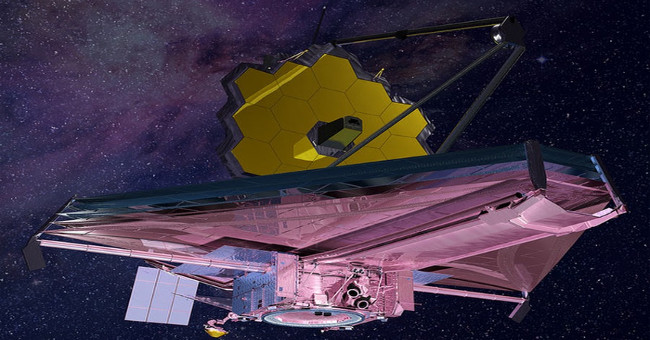
Engineers at the US Aeronautics Agency (NASA) unveil the massive gilded mirror of James Webb space telescope during assembly and testing.
The US Aeronautics and Space Administration (NASA) on March 30 drew a heat map on the super-earth 55 Cancri e, showing great thermal fluctuations between the day and nig…
China once again expressed its ambition to conquer space with the plan to launch the Hubble 300-fold vision with the Thien-3 space station in 2022.
Scientists have found the largest star cluster in the universe to date, with a brightness of 30 million times the Sun.
The European Aeronautics Agency (ESA) announced in October 2018 that it would use the Ariane 5 rocket to launch the James Webb space telescope to orbit.
Not only want to build a large particle accelerator, but now Chinese scientists also launch satellites called DAMPE to study dark matter in the universe.
Given orbit so unaffected by air turbulence, an advantage that no ground telescope has achieved, for the past 16 years, Hubble has made a huge amount of observations, be…
Telescopes, robots, amphibious robots are learning robot tools used in many missions of automatic space exploration, helping people understand more about the mysterious…
Although it is expected to be the most Earth-like planet with an extremely close distance, HD 219134b is still not possible